New Public Spaces Protection Order

New Public Spaces Protection Orders: Responsible ownership of dogs and prohibition of smoking in certain places.

Public Spaces Protection Orders, known as PSPOs are powers that are available to us to deal with persistent and unreasonable nuisances and anti-social behaviour that has a detrimental effect on the quality of life for the local community in a particular area.

They intend to help ensure that the public can use and enjoy public spaces and can help to make West Northamptonshire a better and safer place to live, work and enjoy.

Public Spaces Protection Orders (PSPOs)

Image of the Badge of the Northamptonshire Police

Police advice* on responding to intruder alarms

On hearing an alarm sounding we would expect a member of the public or neighbouring resident to ring the police control room and advise us of the location of the activation and any possible suspicious circumstances.

We would normally expect this type of call on the non-emergency number of 101 during periods of daylight, unless there were suspicious circumstances, however if during the night and because it is sometimes difficult to see around the rear of a property where the alarm is sounding, together with the fact that at certain times our public call queue times are quite excessive, we would accept a call on the 999 emergency line for what could turn out to be a report that we would request an immediate deployment to.

On receipt of the call all details will be taken and an incident created. The incident will be risk assessed and the best course of action will be decided. This does not automatically mean officers will be dispatched to the address this will be dependent on the information supplied by the informant, however the address will be researched in the intelligence system to see if :-

a) The owner has been a recent victim of crime

b) Key contact details are held in the system and if so the owner will be advised

c) Whether any similar reports have been received from the area.

d) Whether the informant can see anything suspicious.

e) Whether any power outages have been reported in the area

The answers to these questions will be used to assess the risk element and if the call handler feels that a request for attendance is necessary then an incident will be sent to the relevant department for officers to attend.

The final decision on deployment is made by the control room inspector and will depend on what resources the inspector has at that particular time bearing in mind that we have to put people before property.

*Northants Police Control Room [Force.Control@northants.pnn.police.uk].
Sunday, May 14, 2017 1:01 PM

Image of the Northamptonshire Police badge

Police Scam Protection Advice

Criminals are experts at impersonating people, organisations and the police. They spend hours researching you hoping you’ll let your guard down for just a moment.

They can contact you by phone, email, text, letters, on social media, or in person. They will try to trick you into parting with your money, personal information, or buying goods or services that don’t exist.

To keep yourself and your devices secure please consider our top 10 tips:

1. Verify any unexpected contact is genuine by using a known number or email address to contact organisations directly – is this caller who they say they are? After hanging up, wait five minutes and make sure you can hear a dial tone before making any other calls, or use your mobile. NEVER allow an unsolicited caller remote access to your computer or devices.

2. Don’t be pressurised into sending money – stop and think and check with a trusted source or person. It’s ok to reject, refuse or ignore any requests. Only criminals will try to rush or panic you. Have confidence in yourself, if it feels wrong to you – it probably is.

3. Use someone you know and trust for shopping & other essentials. Don’t hand money over to someone on the doorstep.

4. Authorities like the DWP and HMRC will never ask for banking details like your password or PIN on the phone or in person. You will NEVER be asked to move money to a ‘safe account’. Police or banking representatives will NEVER ask you to help in an investigation by moving money or withdrawing funds.

5. Check for ID’s and get them verified – genuine officials will be more than happy to wait while you verify their ID.

6. Pick strong passwords – choose Three Random Words with a mixture of upper/lower case, numbers and special characters. Do not use the same password across sites. Enable Two Factor Authentication (2FA) on your accounts and devices that offer it, this provides a second layer of security.

7. Be wary of phishing scams – Don’t click on any links or attachments in unexpected emails.

8. Social Media – For those of you who use social media, make sure that it is set up correctly, review your privacy settings to ensure your profile is appropriately locked down.

9. Use antivirus and ensure you are using the latest versions of software, apps and operating systems on your phones, tablets, desktops and laptops. Update these regularly or set your devices to automatically update so you don’t have to worry.

10. Backups – Always back up your most important data such as your photos and key documents to an external hard drive and / or cloud storage.

Report suspicious texts by forwarding them to 7726, which spells SPAM on your keypad.

If you think you’ve received a phishing email forward to report@phishing.gov.uk.

If you think you’ve fallen victim to a scam contact your bank immediately and report it to Action Fraud by visiting www.actionfraud.police.uk or calling 0300 123 2040.

Message Sent By

Kelly Noble (Police, Social Media Engagement Officer, Corporate Communications, Countywide)

Image of the Northamptonshire Police badge

Police: Please Report Online Where You Can

As concerns over Covid-19 increase, members of the public are reminded of the need to only use the 999 or 101 service where it is absolutely necessary, and to otherwise use the online reporting systems in place.
If the 101 call isn’t urgent, people should use the online forms available at www.northants.police.uk

The public can help reduce wait times by going digital, and thereby free up 999 and 101 for people who really need to speak to the police.

Superintendent Ash Tuckley, who heads the control room, said: “During these unprecedented times, we know that people are worried and they may feel they need to call the police. However we are reminding people that not all calls are emergencies and not all of these require an immediate police response.

“Inevitably what happens is that the queue builds up because everyone is trying to call one central call centre. This can lead to long wait times.

“Last year – 2018/19 – control room operators answered 280,531 calls to the 101 number, averaging 1,178 calls a day, of which 320 were 999 calls. By comparison, on average only 167 crimes were recorded a day.

“The majority of people are already making sacrifices to save lives and we urge everyone in Northamptonshire to follow the advice and help keep us all safe.”

The guidance from the Government on the new measures, and what they mean to you, can be found here: https://www.gov.uk/coronavirus

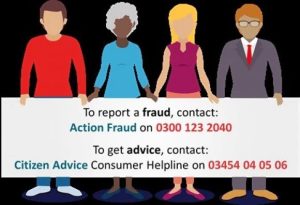
Poster image to report a fraud or get citizen advice using helplines

Preventing Doorstep Crime, Fraud and Scams

Following on from attending the ‘Preventing Doorstep Crime, Fraud and Scams Event’ hosted by Northamptonshire Police, the Daventry and District Over 50’s Forum (DDF) has signed up to the ‘Friends Against Scams’ initiative which aims to protect and prevent people from becoming victims of scams by empowering people to take a stand against scams.
DDF has made a pledge to spread awareness amongst their 700+ membership throughout Daventry and district, and to all other partners in support of the National Trading Standards Scams Team.

  • 53% of people aged 65+ have been targeted by scams and criminals
  • Scams cost the UK £5-10 billion each year.
  • Anyone can be a scam victim, regardless of age, gender, education or economic background.
  • Scam victims might not always admit (or be aware) that they are a victim of a scam. Only 5% of victims report the crime.
  • Scams are the product of organised, predatory criminals who gain trust to exploit and steal money.

The age range of scam victims is 19 – 106 years old. Please see below information on who to contact to report or get advice. Scams are a crime, if you feel that an individual is in immediate danger contact 999. If there is no immediate threat, report the crime via the non-emergency number 101.

Please visit https://www.friendsagainstscams.org.uk/become-a-friend and https://www.thinkjessica.com/where you can order the ‘Don’t Fall for a scam’ booklet from the Charity called Think Jessica, who help protect elderly and vulnerable people from being victims to scams. Copies of this booklet were given out at DDF’s last forum, they are a valuable source of information and includes a ‘no cold-calling’ window sign that residents can display.

The Energy Bills Support Scheme

The Energy Bills Support Scheme Alternative Funding and
The Alternative Fuel Payments Alternative Fund

There are various Government schemes designed to help with energy bills.

Image of the Northamptonshire Police badge

Local crime and policing priorities for Daventry & Rural Neighbourhood Team

Following feedback from residents, your local neighbourhood policing team has announced the top three issues for the Daventry and Ruralarea in the coming months.

To help tackle local crime and anti-social behaviour concerns, Northamptonshire Police invites people living and working across the county to complete a short survey and share their views about any issues affecting their local community.

The findings from the survey, together with local crime statistics and information from partner agencies, help identify the issues that will form the focus of NPT’s work in the following months.

For Daventry and Rural area, the three local priorities from December 2022 until 2023, will be:

1. Road Safety & Road Traffic Offences

2. Burglary

3. Rural Crime

The local neighbourhood team priorities – known as locally identified priorities (LIPs) – are based on the issues that are of most concern in that particular area and are agreed every four months.

To share your thoughts and feedback for the next set of LIPs where you live or work, visit our survey here.

Thank you

Sector Inspector Dave Wakeman/NPT Sergeants Greg Harrison & Matt Moore

Daventry & Rural Neighbourhood Policing Team

Fresh look of the Neighbourhood Watch logo

Same Neighbourhood Watch Charity, Fresh Look

As an exciting start to a brand-new year, we are thrilled to announce that we have refreshed our branding.

We have adopted a new logo, termed the ‘today’ logo as an alternative to our ‘traditional’ logo, which was refreshed in 2017. This means we support two logos from 2023, and our members and supporters can choose to use either one.

Both logos have the same recognisable yellow roundel, proudly displaying our name Neighbourhood Watch. This has been untouched to ensure we retain our incredible 95% brand recognition across England and Wales.

The difference between the two logos is in what is displayed inside the yellow roundel. Our ‘traditional’ logo shows the fantastic relationship between the police and the community, which in some areas, Neighbourhood Watch groups are central to enhancing this special relationship. The retro figures hint at the longevity of Neighbourhood Watch – which has been established within communities for over 40 years. Some areas may prefer to continue to use this logo as it best represents their group.

Our ‘today’ logo was born out of overwhelmingly positive feedback from our temporary 40th-anniversary logo launched in 2022 for that year only. It shows three figures in our refreshed core colours and represents a celebration of diversity. Since we began in 1982, communities across England and Wales have changed and will continue to do so. No matter what the makeup of our communities is, we strive to be embedded within them all and nurture the incredible strength and uniqueness of each one.

Forty years ago, Neighbourhood Watches were restricted to the street in which you live. Today Neighbourhood Watch groups can be set up to cover whole villages or towns, social media groups, or other types of communities such as sports, corporate, or faith groups. The teal banner within our new today logo represents our longevity and relevancy amongst communities from 1982 through to today.

John Hayward-Cripps, CEO of Neighbourhood Watch said: “Both logos represent togetherness – a key strength of Neighbourhood Watch. No matter which logo you choose to use, together, we are making this a better place to live.”

We wish you a fantastic start to this new year.

Best,

Neighbourhood Watch Network, Central Support Team

Cars in a car park

Investing in Northampton car parks

Visitors to Northampton town centre are set to benefit from investment in car parking facilities, making visitors’ experience easier and more seamless.

West Northamptonshire Council (WNC) is investing in Northampton Town’s car parks to improve access and usage for customers. Work has started to install new ANPR (automatic number plate recognition) parking equipment in the following public car parks in Northampton:

  • Grosvenor multi storey
  • St Johns multi storey
  • St Michaels multi storey
  • Commercial Street
  • The Ridings
  • Upper Mounts

Mayorhold multi-storey car park is ageing and in poor condition; these issues are currently being managed but eventually the car park will need major work or replacement.

A decision on whether to install the new equipment in Mayorhold will be taken after members of the council have reviewed options for its future.

The new ANPR technology will simplify the payment and access process for visitors. As you drive in, the cameras will scan your number plate.

You can then pay via the machines or at the barrier upon exit, streamlining the process for visitors. Payment options will include card, cash, chip and pin and contactless payment.

In the coming weeks the council will be launching a parking app for people using these car parks. The app will enable users to pre-register their details and a payment method so they can just come and go as they need without having to visit a pay station.

Blue badge holders will just need to scan the barcode on their badge at the exit barrier, the validity of the badge will automatically be checked, and the barrier will raise. This removes the need for drivers to call and verify the badge manually, ensuring a more seamless process for users.

Cllr Phil Larratt, Cabinet Member for Environment, Transport, Highways and Waste at WNC, said: “We are pleased to be installing new modern technology in Northampton’s car parks. This will enable users to pay much more easily and bring our car parks up to date.

“Our colleagues will be on hand on for the first few days of the ANPR cameras coming into use to provide support for customers. This will also be supported with signage throughout the car parks.”

The technology is only being installed in council owned car parks in Northampton at this time. It is possible that the technology will be introduced at Brixworth and Daventry Country Parks in the future.

As part of its focus on improving car parking facilities across West Northamptonshire, the Council is currently redeveloping and enlarging the Sponne Arcade car park in Towcester.

To find out more about parking facilities across West Northamptonshire visit www.westnorthants.gov.uk/car-parks-west-northamptonshire.

Reminder to have your say – Police and Fire Council Tax Precept

Thank-you to everyone who have already shared their views on the proposed increase to the part of the council tax that goes towards paying for your police and fire services here in Northamptonshire.

We understand the pressures that every household is facing and we genuinely want to know what people are prepared to pay for their emergency services, and you can do so by filling out a short survey here: www.research.net/r/OPFCC2023counciltaxconsultation

Consultation closes on 17th January 2023.